What happened
topapp.lol is tracked here as a App Store app discovery case, not as a claim that the product shares code with Outbid. The useful comparison is the behavior: a scarce public position, a visible amount, and a reason for the listed project or account to share the page. The board adapts the public-ranking mechanic to a new niche. The board was observed on 2026-08-23 with a displayed total of $2,929. That number is a time-stamped public counter in its original category; it is not independently audited revenue.
The page matters because it gives a small team a fast way to test whether status can become distribution. mobile developers seeking a public ranking signal is the plausible paying side. If that buyer does not already have a reason to bring an audience, the board is only a decorative ranking. This case therefore keeps three questions separate: did the site exist, did the mechanism run, and did the mechanism create repeat demand? Only the first two can be answered from the current public record.
Mechanism read
The copied ingredient is not a leaderboard alone. It is the loop between visibility and competition. A participant pays, locks, pledges or spends a balance; the page makes the relative position legible; the next participant sees a reason to respond. topapp.lol changes the scarce object to App Store app discovery, which changes the social context and the likely distribution channel. The board adapts the public-ranking mechanic to a new niche. That change is more important than the visual similarity.
The economic rule also changes the product. “Repeat bids add to an app's lifetime total” determines whether a user is buying a lasting position, a temporary burst, an expiring balance or a final bid. A refundable rule can lower the first-payment barrier but may reduce net revenue; a non-refundable rule can increase urgency but raises trust and compliance questions. A no-payment or pledged board can validate attention while saying nothing about monetisation. The right analysis is therefore a mechanism map, not a revenue leaderboard.
Who pays and why
mobile developers seeking a public ranking signal is the first audience to interview. The reason is not that they like auctions; it is that they already spend time and money trying to be noticed in a crowded feed, directory or category. A board can work when the buyer has a public identity to defend and a channel where the result can be shared. App Store app discovery gives that identity a concrete stage, but it may also create a mismatch: the people who pay may be the same people who can already distribute themselves.
Before building a new clone, ask five practical questions: What event makes someone visit today? What does rank unlock beyond a badge? Who sees the rank without already knowing the site? What happens when a bidder is displaced? Can the owner show a counter, receipt, click or follow-up action? If the answer is only “the top row looks good”, demand is curiosity rather than a business.
Evidence read
Evidence level: the source page and captured board fields support existence and a point-in-time status. the apps endpoint, lifetime totals, and an X launch post is useful discovery evidence, but it does not establish revenue, retention or shared implementation. The strongest observable fields are the page URL, amount type, status, named leader and observation date. A public API can be easier to inspect than a rendered page, yet it still reflects the publisher's own counter and definitions.
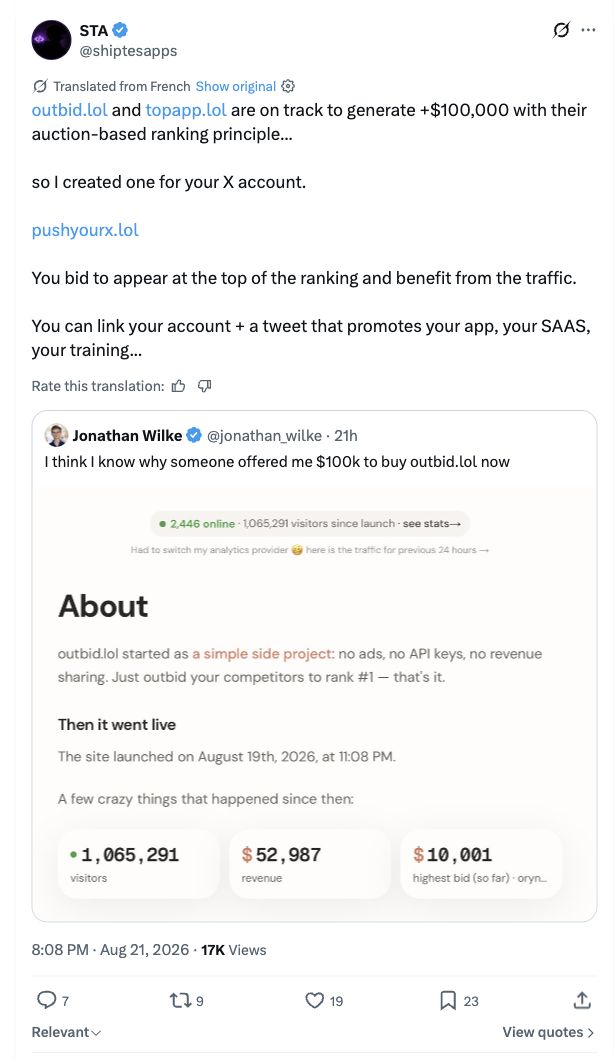
For this case, treat $2,929 as a lead for further checking, not a performance claim. The open question is whether lifetime totals keep the board useful once the novelty fades. A good follow-up would archive the page HTML or API response, record the counter at two or three dates, and compare it with a downstream action. If an X post is available, its screenshot is included as context; the screenshot proves that the post existed at capture time, not that every statement in it is true.
Risk and unknowns
The main risk is a false sense of liquidity. A visible top bid can make a market look active even when only one or two participants are involved. Other risks include unclear refund terms, confusing pledged balances with revenue, platform policy around paid rankings, and a niche that is too small to produce a second wave. The current status should not be treated as a promise that the board will still be live tomorrow.
There is also a content risk for a directory: repeating the same Outbid explanation across every page creates thin, interchangeable SEO pages. Each case must keep its own niche, rule, buyer, evidence and unknowns visible. That is why this page names the exact amount type and a falsifiable next move instead of adding hype or an invented success score.
Opportunity window
The direct-copy window for topapp.lol is best read as a live but unproven test. The copywave has already made the basic interaction legible, so a new entrant should not compete on “being the first”. The remaining opportunity is a native distribution advantage: App Store app discovery must have an audience, data source or ritual that a generic board cannot easily borrow.
The timing signal is the distance between the board and its next action. If a rank sends a user to an install, wallet, profile, video or marketplace, the loop can be measured. If it ends at the board, the site is a spectacle. For this case, the window stays open only long enough to run a small test around a category board that ties every bid to an install or trial event; it does not justify a full clone, paid acquisition or a claim of inevitable growth.
Smallest useful test
Minimum validation move: publish a one-category version for mobile developers seeking a public ranking signal, seed no more than ten entries, and instrument three events—viewing the board, clicking the ranked item, and returning to bid or share. Keep the first payment small and disclose whether it is refundable, final, decaying or only pledged. Record the board total and top position at launch, +24 hours and +72 hours.
The success threshold is not a large dollar number. It is a repeatable reason for a second participant to act without a founder manually chasing every bid. a category board that ties every bid to an install or trial event is the smallest useful test because it changes one variable while keeping the public competition legible. If the test works, add a second category; if not, keep the evidence and change the buyer or distribution channel rather than polishing the clone.
Stop condition
Stop or archive the experiment if the board cannot produce a second independent action, if the public counter cannot be reconciled with its rule, or if the product depends on misleading claims about income or guaranteed exposure. For topapp.lol, also stop treating the record as current if the source page changes its rule without a new observation date. A clean archive is more useful than pretending an old snapshot is still live.
X evidence screenshot
Questions builders ask
Is topapp.lol an official Outbid product?
No official relationship is established by this record. It is catalogued as a public variant or lead because the mechanism or positioning is similar.
Does $2,929 mean revenue?
No. It is a time-stamped public amount in the source site's own category. Refunds, pledges, balances and board totals must not be rewritten as audited revenue.
What should a builder copy from this case?
Copy the observable loop—buyer, scarce position, public feedback and measurable next action—not the interface. Start with the minimum validation move above.